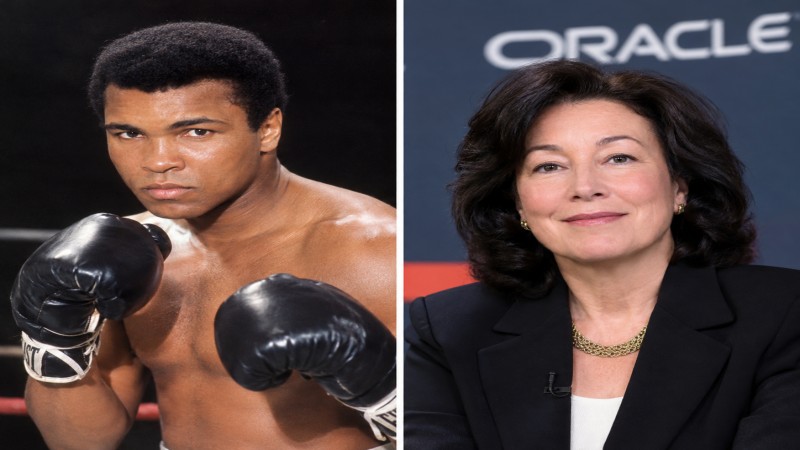
The names Muhammad Ali and Safra Catz represent two very different paths to public influence. Ali became an internationally recognized boxing champion whose legacy extended into civil rights and humanitarian work. Catz built a career in finance and technology, eventually becoming one of Oracle’s most prominent executives.
But are Muhammad Ali and Safra Catz related, did they work together, or is there another documented connection between them?
The available authoritative biographies do not establish a family relationship or professional partnership between the two. Understanding their individual backgrounds helps explain who they were, what they accomplished, and why it is important to distinguish documented facts from speculation.
Are Muhammad Ali and Safra Catz Related?
There is no reliable public evidence establishing that Muhammad Ali and Safra Catz were relatives, business partners, or close personal associates.
Their published biographies describe separate professional lives. Ali’s story centers on boxing, social activism, and humanitarian contributions. Catz’s career focuses on investment banking, corporate strategy, and technology leadership. Neither the National Archives’ biography of Ali nor Oracle’s executive biography of Catz establishes a connection between them.
This distinction matters because two well-known people can appear together in online searches without having a direct relationship.
It is also important not to claim that they never met. Without comprehensive records of every private encounter, that conclusion would go beyond the available evidence. The accurate statement is that a meaningful relationship between them has not been established by the reliable public sources reviewed for this article.
Who Was Muhammad Ali?
Muhammad Ali 1942–2016
A world-famous boxer, Olympic gold medalist, public speaker, and civil rights figure whose influence extended beyond sports.
Muhammad Ali, born Cassius Clay Jr. on January 17, 1942, in Louisville, Kentucky, became one of the most influential athletes of the twentieth century. His speed, footwork, confidence, and distinctive boxing style helped transform the public image of heavyweight boxing.
According to the U.S. National Archives, Ali won the light heavyweight gold medal at the 1960 Olympic Games in Rome. He subsequently pursued a professional boxing career and became a world heavyweight champion.
However, his legacy cannot be understood through sporting achievements alone.
His rise to boxing fame
Ali attracted attention for his unusual combination of athletic ability and outspoken personality. He often promoted his fights with memorable declarations, challenging the expectations traditionally associated with heavyweight boxers.
His success in the ring established him as a major sports figure, but his willingness to speak publicly about political and social issues made his career more complex.
Rather than separating his athletic identity from his personal convictions, Ali became known for both.
His stand against the Vietnam War
In 1967, Ali publicly refused induction into the U.S. military during the Vietnam War. His decision had serious consequences for his boxing career, including the loss of his heavyweight title and suspension from competition.
During this period, he spoke to civil rights organizations and antiwar groups. His position made him a controversial figure at the time, while also contributing to his lasting significance in discussions about conscience, citizenship, and freedom of expression.
His story illustrates how a prominent athlete can influence public debate beyond the boundaries of professional sport.
His lasting legacy
Ali returned to boxing in 1970 and later regained the heavyweight championship. His famous victory over George Foreman in the 1974 Rumble in the Jungle became one of the defining events in boxing history.
In later years, Ali remained a widely recognized public figure associated with humanitarian causes and international goodwill. His life continues to attract interest because it combined athletic excellence with a willingness to take public positions that carried personal costs.
For readers researching his biography, these documented achievements provide a more meaningful account than unsupported claims about unrelated public figures.
Who Is Safra Catz?
Safra Catz Technology and corporate leadership
A business executive recognized for her long career at Oracle and her experience in corporate finance, strategy, and acquisitions.
Safra Catz is an American business executive born in Israel. She built her professional career in investment banking before joining Oracle in 1999, where she advanced through senior management positions.
Oracle’s official executive biography identifies her as executive vice chair of the company’s board of directors. It also documents her previous responsibilities as president, chief financial officer, executive vice president, and senior vice president.
Her career offers a different example of influence from Ali’s. Rather than gaining international recognition through sport and activism, Catz became known for managing complex corporate responsibilities in the technology industry.
Education and early career
Catz studied at the University of Pennsylvania, earning an undergraduate degree and a law degree. She subsequently worked at Donaldson, Lufkin & Jenrette, an investment banking firm, where she rose to the position of managing director.
This experience provided a foundation in finance, negotiations, and business transactions. Those skills later became relevant to her responsibilities at Oracle, a company operating in enterprise software, databases, and cloud infrastructure.
Her career demonstrates how financial expertise can lead to senior leadership positions within a major technology company.
Her leadership at Oracle
Catz joined Oracle in 1999 and held several senior roles before becoming co-chief executive officer in 2014 alongside Mark Hurd. Following Hurd’s death in 2019, she continued as the company’s sole CEO.
During her tenure, Oracle pursued acquisitions and expanded its business across enterprise software and related technology markets. Catz became closely associated with the company’s financial management, corporate strategy, and acquisition activity.
In September 2025, Oracle announced that Clay Magouyrk and Mike Sicilia would become its CEOs, with Catz moving to the position of executive vice chair of the board. Her current role is therefore distinct from her former position as CEO.
For anyone researching her career, this distinction is important: an executive’s former title should not be presented as their current position.
Her professional influence
Catz’s career illustrates the importance of strategic decision-making in large organizations. Technology companies must balance product development, customer needs, financial performance, acquisitions, and long-term investment.
Senior executives help coordinate these competing priorities while remaining accountable to boards, shareholders, employees, and customers.
Although her professional field differs significantly from Ali’s, her biography provides a useful example of how influence can develop through sustained leadership in business rather than public performance.
Muhammad Ali and Safra Catz: A Comparison
Comparing the two figures is useful when the goal is to understand their separate achievements. It should not be mistaken for evidence of a personal or professional relationship.
| Category | Muhammad Ali | Safra Catz |
|---|---|---|
| Primary field | Professional boxing and public activism | Corporate leadership and technology |
| Birthplace | Louisville, Kentucky, USA | Israel |
| Best-known achievement | Olympic gold medal and heavyweight boxing championships | Senior leadership at Oracle |
| Professional background | Athlete, public speaker, activist | Investment banker and technology executive |
| Major public influence | Sports, civil rights, and humanitarian work | Business strategy, corporate finance, and technology |
| Documented relationship between them | No established connection in the authoritative biographies reviewed | No established connection in the authoritative biographies reviewed |
The information in this comparison is based on the National Archives’ account of Ali and Oracle’s official biography of Catz.
The contrast is straightforward. Ali’s influence came primarily from athletic accomplishment and his public stance on important social issues. Catz’s influence developed through corporate management and financial expertise.
Both biographies show how individuals can become influential in different environments, but that broad similarity does not establish that they knew or worked with one another.
Why Do People Search for Muhammad Ali and Safra Catz Together?
A combined search for two prominent individuals can have several possible explanations. Readers may be investigating a claimed relationship, researching a comparison, checking a fact they encountered online, or exploring biographies for a particular publication.
In this case, the exact reason the two names are being searched together cannot be established from the keyword alone.
Several distinctions help answer the query responsibly.
Online mentions are not proof of a relationship
When websites repeatedly publish pages containing two names, search engines may display those pages for searches involving both individuals. That visibility does not establish that the people are related, knew each other, or collaborated professionally.
A credible connection requires evidence such as a reliable interview, an official record, a well-sourced biography, or a documented business relationship.
Similar prominence does not mean shared history
Ali and Catz achieved public recognition in different fields. Both have biographies worth studying, but their respective achievements do not create a direct link between them.
A comparison can still be informative when it focuses on their careers, public influence, and different paths to success. The article should simply make clear when it is comparing general themes rather than documenting a shared history.
Uncertainty should remain visible
The absence of a documented relationship in the sources reviewed does not prove that the two individuals never encountered one another.
It does mean that a publisher should not invent a friendship, family connection, business partnership, or meeting to make the article more intriguing. Accurate reporting is more useful than an unsupported story.
What Their Stories Teach Us About Influence
Although Muhammad Ali and Safra Catz worked in different fields, their careers offer two distinct examples of public influence.
Ali’s life shows how athletic achievement can create a platform for wider social engagement. His refusal to be inducted into the military demonstrated that his convictions could take precedence over professional opportunity, even when that decision carried significant consequences.
Catz’s career illustrates a different form of influence. Her progression from investment banking to senior technology leadership shows the importance of financial knowledge, organizational experience, and strategic decision-making in corporate environments.
These observations are interpretations of their documented careers, not evidence that one influenced the other.
Their stories also demonstrate why biographies should be grounded in verifiable information. Readers benefit most when an article separates established events from interpretation and clearly identifies what remains unknown.
The Importance of Accurate Biographical Research
When researching two public figures, the best approach is to begin with primary or authoritative sources rather than repeated claims on other blogs.
For Muhammad Ali, the U.S. National Archives provides a historical overview of his early life, Olympic achievement, boxing career, and opposition to the Vietnam War.
For Safra Catz, Oracle’s official executive biography provides information about her career, former leadership responsibilities, and current board role.
Using these sources helps establish the individual facts before drawing comparisons. It also reduces the risk of repeating outdated job titles or presenting speculation as a confirmed relationship.
For publishers, this approach has practical value. A well-researched article can answer the reader’s main question early, provide enough background to explain the answer, and acknowledge the limits of the available evidence.
It does not need to manufacture a dramatic connection to become informative.
Conclusion
Muhammad Ali and Safra Catz built influential careers in very different fields. Ali became a legendary boxer and a prominent voice in civil rights and antiwar discussions, while Catz established herself as a senior executive in the technology industry.
The authoritative biographies reviewed for this article do not establish that they were relatives, business partners, or close personal associates. Their names can be discussed together as part of a factual comparison, but a direct relationship should not be claimed without reliable evidence.
The most useful takeaway is simple: understanding public figures begins with the facts about their lives, not assumptions created by their names appearing together online. See more
7. Frequently asked questions
1. Are Muhammad Ali and Safra Catz related?
No publicly verified evidence establishes a family relationship between Muhammad Ali and Safra Catz. Their authoritative biographies document separate careers in boxing and technology leadership.
2. Did Muhammad Ali and Safra Catz work together?
No documented professional collaboration between them has been established in the sources reviewed. Ali’s career focused on boxing and activism, while Catz built her career in finance and corporate technology.
3. Who was Muhammad Ali?
Muhammad Ali was an American heavyweight boxing champion and 1960 Olympic gold medalist. He was also known for his opposition to the Vietnam War, civil rights advocacy, and humanitarian activities.
4. Who is Safra Catz?
Safra Catz is a business executive known for her long career at Oracle. She previously served as its CEO and is identified by Oracle as executive vice chair of its board of directors.
5. What made Muhammad Ali influential beyond boxing?
Ali’s public opposition to military induction during the Vietnam War and his engagement with civil rights and antiwar organizations expanded his influence beyond sports. His career became part of broader discussions about personal conviction and freedom of expression.
6. What is Safra Catz known for in business?
Catz is known for corporate leadership at Oracle, including her work in finance, strategy, and acquisitions. She held several senior positions before becoming CEO in 2014.
7. Why do people search for Muhammad Ali and Safra Catz together?
The exact reason for the combined search is unclear. It may reflect interest in a possible connection or a comparison of their biographies, but the keyword alone does not establish the searcher’s motivation or a relationship between them.